Exercises
This document contains instructions, some answers, comments, tips and tricks, and further explanations for the exercises.
In the first 6 exercises the answers start with identifying the
population and parameter being studied.
In the answers I also mention the Test Statistic that can be used to
test the hypothesis, although this is not requested. This is always a
statistic of a sample used.
Exercise 9.1
Population: 1000 students with age 30+ at teachers’ college
Parameter: \(\mu\): mean score for SSHA
test
H0: \(\mu\) = 115
HA: \(\mu\) > 115
Test Statistic: \(\bar{x}\), sample mean SSHA score in an SRS of 45 students at the teacher’s college aged 30+.
Note. I assume that ‘a better attitude’ leads to a higher SSHA score.
Exercise 9.2
Population: all Jordanian children
Parameter: \(\mu\): mean amount of
hemoglobin per deciliter of blood in g/dl
H0: \(\mu\) = 12
HA: \(\mu\) < 12
Test Statistic: \(\bar{x}\), sample mean amount of hemoglobin in an SRS of 50 Jordanian children
Exercise 9.3
Population: all students at Simon’s college Parameter: p, proportion (or percentage) of left-handed persons
H0: p = 0.12
HA: p <> 0.12
Test Statistic: \(\hat{p}\), proportion of left-handed people in an SRS of 100 students at Simon’s college
Exercise 9.4
Population: all teens at Yvonne’s highschool
Parameter: p, proportion that seldom or never argue with friends
H0: p = 0.72
HA: p <> 0.72
Test Statistic: \(\hat{p}\), proportion students that seldom or never argue with friends in an SRS of 150 students at Yvonne’s highschool
Exercise 9.5
Population: thermostats manufactured by the manufacturer of
Mrs. Starnes thermostat
Parameter: \(\sigma\) standard
deviation of the temperature if the thermostat is set at
50oF.
H0: \(\sigma\) = 3
HA: \(\sigma\) > 3
Test Statistic: s, standard deviation in a randomly chosen couple of days on which the temperature was set on 50oF.
As an alternative, use the Variance \(\sigma\)2.
H0: \(\sigma\)2 = 9
HA: \(\sigma\)2
> 9
Exercise 9.6
Population: All ski jumpers that join the specific competition
Parameter: \(\sigma\), the standard
deviation of the distances in the jumps
H0: \(\sigma\) = 10
HA: \(\sigma\) > 10
Test Statistic: s, standard deviation in an SRS of jumps at the specific ski spring track
As an alternative, use the Variance \(\sigma\)2.
Exercise 9.7
The form of the H0 hypothesis always is H0:
parameter = ….
So in this case
p: proportion of all students atthe highschool that approve the parking
situation
H0: p = 0.37
Ha: p > 0.37 (greater than, because the test is performed
to find support for an improved student satisfaction)
Exercise 9.8
\(\hat{p}\) is a sample
characteristic (a random variable)
Hypotheses are statements about a population parameter, not about a
sample charateristic. For the correct hypotheses, see answer to 9.7
Exercise 9.9
\(\bar{x}\) is a sample
characteristic (a random variable)
Hypotheses are statements about a population parameter, not about a
sample charateristic.
Correct hypotheses in this case:
\(\mu\): average birth weight of all
babies (in the US?) whose mothers didn’t see a doctor before
delivery
H0: \(\mu\) = 1000
grams
Ha: \(\mu\) <> 1000
grams
Note 1. Because nothing is said about the direction of the
study, I use ‘is not equal to’ in the Ha.
Note 2. A little bit strange hypotheses, 1000 grams is a very
low birth rate.
Exercise 9.10
The form of the H0 hypothesis always is H0:
parameter = ….
So in this case:
\(\mu\): average birth weight of all
babies (in the US?) whose mothers didn’t see a doctor before
delivery
H0: \(\mu\) = 1000
grams
The alternative has to use the value used in the
H0-hypotheses, so:
Ha: \(\mu\) <> 1000
grams (or, depending on what is exactly been studied, Ha:
\(\mu\) < 1000 grams or
Ha: \(\mu\) > 1000
grams)
Exercise 9.11
- Setting and hypotheses see 9.1. If H0 is true, the average score for 30+ students at the college equals 115, so it doesn’t differ from the other students
- Assuming that the average score for all 30+ students at the college
is 115, the probability of an average score of 125.7 in an SRS from
these 30+-students with n = 45 equals 0.0101.
Or, with \(\mu\) the average score all 30+college students at the college and \(\bar{x}\) the average score in an SRS of 45 30+-students at the college: P(\(\bar{x}\) <= 125.7 | \(\mu\) = 115) = 0.0101
Exercise 9.12
- If the H0 hypothesis is true, than the average hemoglobin level for Jordanian children is 12 (g/dl); so on average Jordanian children are not anemic.
- P-value = 0.016, this means that if the average hemoglobin level for Jordanian children indeed equals 12 (g/dl), the probability that in a SRS of 50 Jordanian children the mean hemoglobin level equals 11.3 (g/dl) or less is 0.0016.
Exercise 9.13
P-value = 0.2184
This means that if H0 is true, the probability that a sample
result will be found as Simon did or more extreme, is 0.2184. So the
sample result is not unlikely.
If the significance level used, \(\alpha\) = 0.10, H0 will not be
rejected.
If the significance level used, \(\alpha\) = 0.05, H0 will not be
rejected.
In both cases the test doesn’t provide convincing evidence that the proportion of ‘lefties’ at SImon’s college differs from that of all adults in the US.
Exercise 9.14
Population: all teens at Yvonne’s highschool
Parameter: p, proportion that seldom or never argue with friends
H0: p = 0.72
HA: p <> 0.72
Test Statistic: \(\hat{p}\), proportion students that seldom or never argue with friends in an SRS of 150 students at Yvonne’s highschool
Test result: 96 students out of 150 seldom or never argue with friends, \(\hat{p}\) = $ = 0.64
P-value = 0.0291 (given)[^1]
If H0 is true, the probability that the sample proportion is
as extreme or more extreme than the observed one - that is in this case
less than 0.64 or more than 0.80 - is 0.0291
If \(\alpha\) = 0.05
Exercise 9.15
P-value = 0.0101 (given see exercise 9.11) if \(\alpha\) = 0.05, H0 is rejected,
because P-value < \(\alpha\)
if \(\alpha\) = 0.01, H0 is
not rejected, because P-value > \(\alpha\)
Exercise 9.16
P-value = 0.0016 (given see exercise 9.11) if \(\alpha\) = 0.05, H0 is rejected,
because P-value < \(\alpha\)
if \(\alpha\) = 0.01, H0 is
rejected, because P-value < \(\alpha\)
Exercise 9.17
H0 is either true or false, that doesn’t depend on a sample result. The P-value is not the chance that the H0 hypothesis true, but it is a conditional probability, P(a sample result as found or even more extreme in the direction of HA | H0 is true).
Exercise 9.18
The student forgets to mention that it is a conditional probability and that it is the probability \(\hat{p}\) = 0.64 or more extreme in the diretion of the HA hyoothesis.
Exercise 9.19
It is incorrect to compare the P-value with the proportion that is
tested.
Besides that, data never prove that HA is true, data can
support the HA hypothesis.
Exercise 9.20
Not rejecting H0 is not the same as accepting
H0.
The conlucion should be, ‘because P-value is greater dan \(\alpha\) = 0.05, we do not reject the
H0 hypothesis’.
Exercise 9.73
Part (a)
S(TATE)
\(\mu\): the average speed of all
drivers in the construction zone
H0: \(\mu\) = 25 mph
HA: \(\mu\) > 25
\(\alpha\) is not given; I will use
\(\alpha\) = 0.05
P(LAN)
Use a one-sample t-test for the mean, based on an SRS of 10 drivers to
test the hypothesis.
Condtions:
- Random sample? Yes.
- 10% condition? Yes, 10 drivers can be assumed less than 10% of all drivers in the zone.
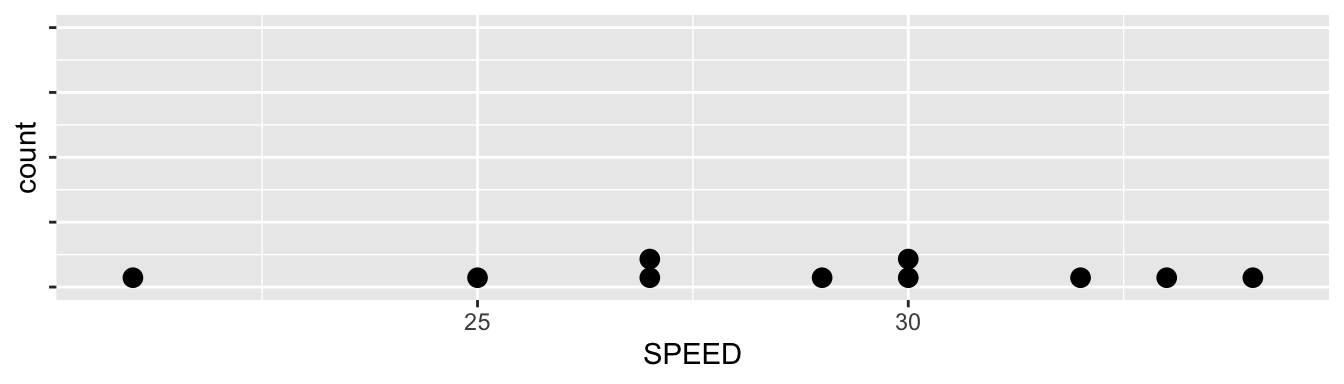
- CLT? (that is the same as Normal/10% condition) Yes, see graph below. No extreme outliers and no skewness in the sample distribution, CLT can be used, i.e. it can be assumed that the sampling distribution of the sample mean is approximately normal.
D(O)
Perform the t-test, using TI84.
Output t-test in R
##
##  One Sample t-test
##
## data:  data$SPEED
## t = 3.0511, df = 9, p-value = 0.006884
## alternative hypothesis: true mean is greater than 25
## 95 percent confidence interval:
##  26.51697      Inf
## sample estimates:
## mean of x
##      28.8
C(ONCLUDE)
From the output we see: p-value = 0.007
Because p-value < \(\alpha\),
H0 is rejected in favor of HA.
The data support the hypothesis that the average speed of all drivers at
the construction zone exceeds 25 mph.
REMARK
It can be questioned whether in a practical sense this is the most
interesting.
Maybe it is more interesting to state a hypothesis about the proportion
of drivers who drive faster than 25 mph. To perform a test for a
proportion, a sample with n=10 does not suffice, because with n = 10,
one ‘success’ more or less makes a difference of 10%.
Part (b)
According to the theory:
- a type I error means rejecting H0 while it is actually true
- a type II error means not rejectiong H0 while HA is actually true
This means that:
- if H0 is rejected, a type I error can be made
- if H0 is not rejected, a type II error can be made
In this case, H0 is rejected, so a type I error can be
made.
In the context this means, that based on the sample it is concluded that
the average speed at the construction zone is more than 25 mph when in
reality this is not true.